

Top Custom Software Development Companies in Europe (2026)
Plenty of lists claim to rank the best custom software development companies in Europe. Most cycle through the same ten names, lean on logo recognition, and conveniently skip over the firms that would actually be the right fit for your project.
This one takes a different approach. The companies below were chosen for having a verifiable track record, a clear point of view on how they operate, and — in most cases — a profile that doesn’t show up on every other list. Europe’s custom software market is projected to surpass $166 billion in 2025. The real question isn’t whether strong partners exist here — it’s how to tell them apart before you’ve signed anything.

Table of contents
Why European Custom Software Still Makes Sense in 2026
The case for European development partners has only gotten stronger over the past few years.
GDPR compliance is built in, not bolted on. Firms that have operated under the regulation since 2018 treat privacy-by-design as a default architectural principle, not an audit checkbox added six months before launch. For companies handling personal data in Europe, that translates into fewer legal transfer assessments, cleaner data architecture from the start, and a partner who already understands what your DPO will ask about.
Time zones work in your favor. CET ±2 hours covers Poland, Romania, the Czech Republic, Estonia, Germany, the Netherlands, and Finland — the bulk of serious engineering talent. That means morning standups with London or DACH teams are routine, not a scheduling headache, and US East Coast async coverage works fine too.
The talent economics still hold up. Senior developers in Central and Eastern Europe remain roughly 40–60% cheaper than UK or US equivalents, without the quality gap that existed a decade ago. DORA and NIS2 compliance requirements are also pushing European enterprises toward EU-based partners, creating a structural tailwind for firms in this market.
Top Companies
1. Boldare

HQ: Gliwice, Poland | Founded: 2004 | Team: 200+ | Rates: $70–150/hr
Boldare earns the top spot here for a reason that has nothing to do with size: they build custom software around product outcomes, not delivery milestones. Where most firms hand over a codebase and move on, Boldare operates as a long-term product partner — which is why 80% of clients return for further work.
The model holds up because of how their teams are structured. Cross-functional squads — engineers, designers, product specialists — own full vertical slices of a product rather than individual layers. A Boldare developer doesn’t just build to spec; they’re expected to understand why the spec was written that way in the first place.
They work across React, Node.js, TypeScript, and cloud-native architecture on AWS and GCP, with AI embedded directly into delivery workflows. This is where Boldare’s AI Product Development & Consulting practice comes in — they report a 20–40% acceleration across testing, code generation, and performance profiling, achieved through their broader AI Adoption for Engineering Organizations and AI-Powered QA & Test Automation services. For companies dealing with aging systems, Boldare also runs Legacy Code Modernization with AI, and for teams building agent-based workflows, their Agentic AI Implementation service is worth a look.
One of their engineers authored Marble.js, an open-source functional reactive framework for Node.js backends — the kind of contribution that signals how seriously the team engages with the technology beyond client delivery.
Their client portfolio includes BlaBlaCar, Bosch, Decathlon, Volkswagen Financial Services, ING, and sonnen, with a 4.9 Clutch rating across 60+ verified reviews and 100% of reviewers citing strong project management.
Best for: scaleups and mid-market companies looking for a long-term product partner with AI-native delivery; strong in fintech, healthtech, SaaS, and digital transformation.
2. Miquido
HQ: Kraków, Poland | Founded: 2011 | Team: ~170 | Rates: $50–99/hr
Miquido occasionally shows up on broader lists but rarely gets the attention their client roster deserves. Warner Music Group, Abbey Road Studios, Dolby, Skyscanner, BNP Paribas, AXA, HelloFresh — these aren’t the clients of a mid-tier studio running simple delivery tickets. They’re the clients of a firm someone senior at a major company specifically vouched for.
Their core strength is mobile engineering — Flutter, React Native, native iOS and Android — with backend and AI layered on top. The Skyscanner engagement is particularly telling: Skyscanner’s own Product Owner has written publicly about how Miquido adopted Theory of Constraints methodology mid-engagement to improve throughput and cut bugs, the kind of operational detail that separates a real delivery partner from a body shop.
Nine out of ten projects at Miquido come from referrals — a hard number to fake for a 170-person studio, and a sign of delivery quality compounding over time. Minimum project size starts at $25,000 with an MVP turnaround typically framed around three months, making them accessible without being cheap.
Best for: companies building mobile-first or cross-platform products, especially in fintech, entertainment, healthcare, and eCommerce.
3. Grape Up
HQ: Kraków, Poland | Founded: ~2012 | Stack: Kubernetes, Cloud Native, AWS, Azure, AI/MLOps
Grape Up is one of the most technically specific firms in European custom software, and one of the least visible outside engineering circles. They built their reputation in the early days of cloud-native computing and Kubernetes, so their expertise is earned rather than picked up through a recent pivot toward whatever’s trending.
Their client list — Cummins, Adidas, Hertz, Solaris, Volkswagen, Volvo — leans heavily toward heavy industry and automotive, where cloud-native infrastructure decisions carry multi-year consequences. One public case study involves a Dutch government ministry that hired them to build a private Kubernetes environment for thousands of internal and third-party developers; the platform went live within months, and the ministry’s Product Owner described the value-for-money ratio in unusually positive terms for a government client.
Their newest product, Cloudboostr, is an EU-sovereign open-cloud platform built entirely on upstream open-source components — Kubernetes, OpenStack, no proprietary dependencies at any layer — positioned squarely for enterprises navigating data residency and cloud sovereignty concerns under NIS2.
Best for: enterprises building or migrating cloud-native infrastructure, particularly in automotive, manufacturing, public sector, and AI/MLOps platform work.
4. Taiste

HQ: Helsinki, Finland | Founded: 2009 | Team: ~60
Taiste is the kind of company that shows up consistently in shortlists compiled by people who’ve actually done the research, rather than in generic rankings by people who haven’t. This Finnish boutique treats design and engineering as genuinely equal disciplines, not separate departments handing work off to each other.
Roughly half their team is designers, half engineers — an unusual split with real consequences. Products built at Taiste tend to have fewer UX-to-engineering translation errors, because the people making design decisions sit next to the people building the system. The firm has sustained 20–30% annual organic growth for several years without outside funding, covering custom product development, legacy modernization, AI and data solutions, and UX/UI design from a single integrated team.
Best for: companies that want design-led product development with serious engineering depth, especially in SaaS, service design, and Nordic digital transformation projects.
5. Serokell
HQ: Tallinn, Estonia (with an office in Paris) | Founded: 2015
Serokell is the most technically specific company on this list, deliberately so. They build custom software in functional programming languages — primarily Haskell, also Elixir, Rust, and TypeScript — for problems where correctness and reliability are genuinely non-negotiable: fintech systems, blockchain infrastructure, biotech applications, data-intensive platforms.
This isn’t a positioning gimmick. It reflects a real conviction that mathematical rigor in code produces systems that are harder to break in the ways that matter most. Serokell has contributed to multiple blockchain platforms, including Cardano and Tezos, and their in-house Serokell Labs bridges academic and commercial work in a way few commercial software firms attempt.
The practical caveat: Haskell and functional-programming depth isn’t universally useful. But for fintech, biotech, or research-heavy software where system correctness is existential, they’re a firm most vendor lists won’t point you toward — which is exactly why they’re worth knowing about.
Best for: fintech, blockchain, biotech, and research applications where mathematical correctness and functional programming expertise are genuine requirements.
6. Software Mansion
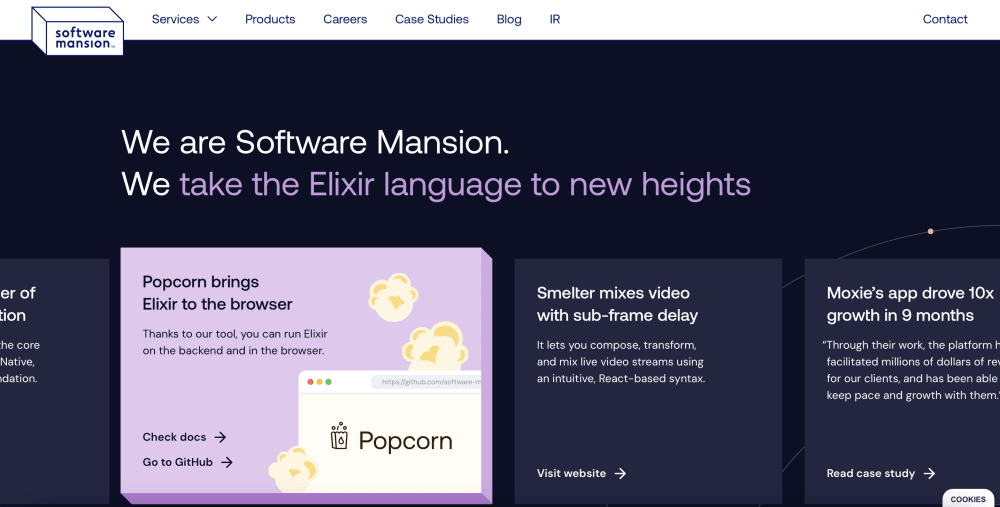
HQ: Kraków, Poland | Founded: 2012
Software Mansion is the least-marketed company on this list, and arguably has the strongest open-source profile of any Polish studio outside Boldare. They’re core contributors to React Native and the primary maintainers of React Native Reanimated, one of the most widely used animation libraries in the React Native ecosystem. If you’ve used a smooth mobile animation in a React Native app over the last four years, there’s a decent chance Software Mansion’s code was involved somewhere.
That level of open-source contribution is a meaningful differentiator — it means their engineers aren’t just consumers of the ecosystem, they understand it at the level of people who helped build parts of it. They work across React, React Native, Python, Elixir, Ruby on Rails, Swift, and Java, focused on performance-critical applications like real-time audio/video, mass storage, and scalable streaming platforms.
Their portfolio spans fintech, entertainment, and healthcare. They don’t appear on most vendor rankings because they simply don’t invest heavily in marketing — for the right client, that’s a feature, not a limitation.
Best for: mobile-first or performance-critical applications, and companies that want React Native expertise at the ecosystem-contributor level.
7. Accedia

HQ: Sofia, Bulgaria | Founded: 2012 | Team: 300+
Bulgaria doesn’t get the same attention as Poland or Romania in European software rankings, which means Accedia is consistently undervalued relative to what they actually deliver. They’ve built their practice around enterprise Java and .NET backends, and around regulated-industry engineering — healthcare, financial services, insurance, utilities.
They run delivery through small senior teams rather than large blended ones, avoiding the dilution problem that affects bigger nearshore providers. Their European client base leans heavily DACH and UK. Notably, they publish their custom-software evaluation methodology openly — an unusual move for a vendor, and a sign they’re confident enough in their process to let clients see exactly how decisions get made.
Best for: enterprise buyers in regulated verticals — healthcare, finance, insurance — who want Eastern European engineering depth without the overhead of the largest firms.
How to Evaluate a Custom Software Firm Before Committing
Request technical discovery before a project proposal. Any firm willing to quote scope and timeline without seeing the codebase or running architecture workshops is guessing. Legitimate partners propose discovery as the first engagement, not an afterthought.
Ask specifically who will be on your team. Get names, check LinkedIn, confirm they’re actually employed by the firm rather than subcontracted, and ask directly whether these are the people doing the work or the people managing others who do it.
Look closely at how they handle IP transfer. Some firms structure delivery in ways that create dependency — bespoke tooling, undocumented internal frameworks, proprietary deployment infrastructure. Clean code ownership and documented architecture from day one represents a fundamentally different risk profile.
Talk to a client who’s exited the relationship. References from active clients are useful; references from clients who finished a project and moved work in-house are more useful, because they reveal what the actual handover looked like.
FAQ
What does custom software development cost in Europe?
Rates run from roughly $40–60/hr for Eastern European staff augmentation firms up to $100–200/hr for senior-led boutiques in Poland, Finland, or Western Europe. For production-grade custom software with real business logic, $70–120/hr for a dedicated team is a reasonable working expectation.
How long does a custom software project take in Europe?
MVP-scale projects with defined scope typically run 3–6 months. Full product builds with discovery, design, and iterative development run 9–18 months. Be wary of any firm quoting a fixed timeline before seeing your requirements — that’s not a confident estimate, it’s a sales number.
Is nearshoring to Central and Eastern Europe still competitive in 2026?
Yes. The rate advantage has narrowed slightly compared to 2019–2021, but the quality argument has only strengthened. Polish, Romanian, and Estonian engineers now have a decade of production experience in cloud-native architecture, microservices, and AI-integrated systems.
What’s the difference between custom software and product development?
Custom software means building a system tailored to specific requirements — internal tooling, platform infrastructure, enterprise applications. Product development means building something you’ll sell or distribute to customers, with the associated focus on UX, market fit, and iteration. Many firms claim to do both; fewer do both well. If you’re building a product, look for a firm with design embedded directly in the delivery model.
Does GDPR affect which European firm I choose?
For companies processing EU citizen data, yes, in practical terms. A firm operating under GDPR for 7+ years has built compliance into how it designs data models, handles access controls, and structures APIs — and that shows up in architectural decisions made in the first weeks of a project.
How do I verify claims on a vendor’s portfolio page?
Named client references are the baseline — call them. Clutch reviews are independently verified and more reliable than testimonials on a vendor’s own site. Asking a vendor to connect you directly with a former client is a reasonable request; reluctance to do so tells you something on its own.
Share this article: